
Reading Feng Ruohang’s recent teardown, AI Penetration Might Not Be As High As You Think, hit me with a visceral sense of resonance—and a cold sweat. As a founder building in the trenches of AI infrastructure and tooling, the numbers felt all too real.
Feng's article: Chinese original / English translation.
Until recently, driven by the conviction that AI is an irreversible tidal wave, I set an aggressive, uncompromising strategy for our company: make MCP (Model Context Protocol) R&D the bedrock of our existence, and define our primary customer base as LLMs (Agents) first, and humans second.
The first-principles logic seemed bulletproof. If the primary caller of software is inevitably shifting from human fingers to tireless autonomous Agents, why waste cycles competing over traditional GUIs and human-centric workflows? Why not pave the roads and build the standardized tool interfaces (MCP) directly for the models, positioning ourselves right at the endgame?
Then we opened the ledger. When we reconciled our own ground-truth instincts with Feng’s five-tier global AI funnel, a brutal commercial reality stared back at us: AI is undeniably the future, but real 'deep penetration' is still in its infancy. If we bet the entire company today on pure LLM-native monetization, we might starve before dawn.
I. Reconciling the Ledger: What Looks Like an Ocean Is Still a Geek Pond
When we first mapped out our strategy, I did a back-of-the-envelope estimate of heavy LLM users: roughly a few hundred thousand in China, and maybe a million-plus overseas.
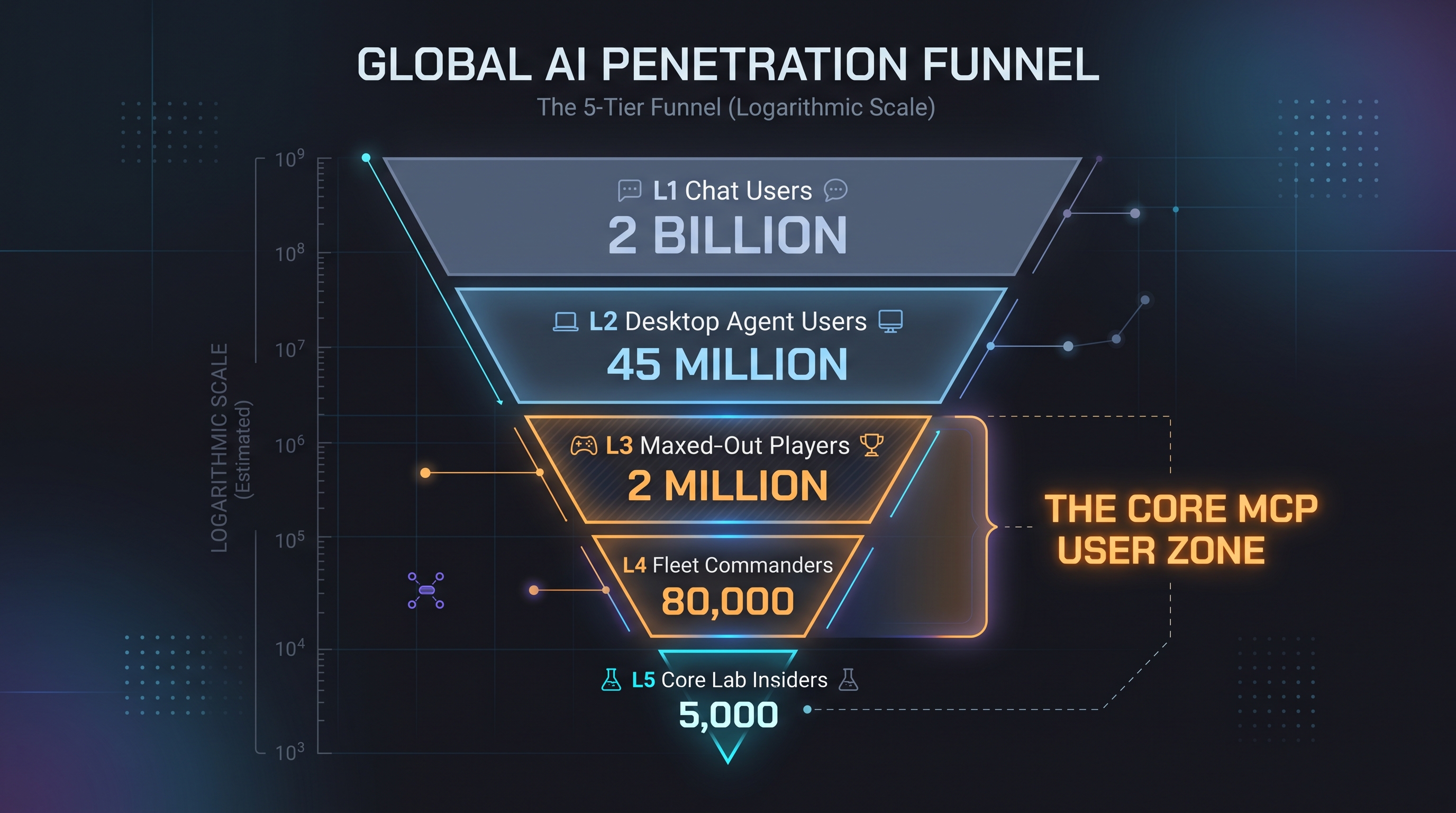
Looking at Feng’s Fermi estimation, the numbers locked together with eerie precision. In his five-tier funnel (L1 Chat Users: 2B → L2 Desktop Agent Users: 45M → L3 Maxed-Out Players: 2M → L4 Fleet Commanders: 80k → L5 Core Lab Insiders: 5,000), the global pool of L3 Maxed-Out Players—people who consistently burn through a $200/month top-tier subscription or run automated pipelines on hefty corporate bills—comes out to right around 2 million people.
| Funnel Tier | Global Scale | Behavioral Definition | MCP Ecosystem Role |
|---|---|---|---|
| L1: Chat Users | ~2 Billion (24%) | Used an AI chatbot at least once in the past month (glorified search bar). | Zero direct MCP awareness |
| L2: Desktop Agent Users | ~45 Million (0.55%) | Delegate hands-on work to an Agent weekly (Claude Code, Codex, ChatGPT Work). | Passive / pre-packaged only |
| L3: Maxed-Out Players | ~2 Million (0.025%) | Consistently max out a $200/mo top-tier plan or run heavy enterprise pipelines. | Early MCP adopters |
| L4: Fleet Commanders | ~80,000 (0.001%) | Concurrently orchestrate 10+ Agents across multiple maxed-out plans daily. | Core heavy MCP power users |
| L5: Core Lab Insiders | ~5,000 | Core researchers inside frontier labs with virtually uncapped compute access. | Internal custom frontier tooling |
Digging one layer deeper makes it even starker. Personally, I maintain about five maxed-out, top-tier subscriptions across my daily workflow, spanning GPT, Claude, Grok, and GLM. Living in an echo chamber of fellow builders, it’s easy to hallucinate that everyone works this way. Yet, when fitted against the Pareto tail of consumer credit card spend, users who cross-pollinate across multiple frontier platforms and concurrently orchestrate multi-agent workflows sit right at the narrow bottleneck between the top of L3 and L4 (Fleet Commanders—only ~80,000 people worldwide).
This exposes a sobering truth: Who is the actual core user of MCP today? It is certainly not the 2 billion L1 users treating LLMs like a glorified search bar. It isn’t even the 45 million L2 dabblers occasionally spinning up Cursor or a desktop agent. The people who actually have the motivation, workflow complexity, and technical necessity to configure MCP Servers—allowing LLMs to autonomously invoke external tools and data sources via standardized protocols—are heavily concentrated in that narrow sliver of L3 elites and L4 commanders. We are talking about tens of thousands, maybe a few hundred thousand geeks globally.
II. Recalibrating the Business Math: Why a 100k-User Market Can’t Carry Core Revenue
Translating 'technical faith' into a P&L statement makes the problem sharp and immediate:
- 1. The TAM Illusion: One in four people on Earth has touched AI (L1), creating an intoxicating mirage of an infinite market. Yet only one in 100,000 commands an Agent fleet (L4). Anchoring today’s primary revenue to a niche market of tens of thousands puts a suffocatingly low ceiling on the business.
- 2. Extreme Polarization in Willingness to Pay: As a16z’s real-spend data reveals, the median monthly spend for paying AI users is a flat $25, and only 13% of paying users are willing to pay for a second AI product simultaneously. The vast majority of compute budgets are locked up by foundational model giants like OpenAI and Anthropic, leaving razor-thin monetization margins for independent ecosystem tooling.
- 3. The Quota & Compute Wall: What increasingly bottlenecks the leap from L3 to L4 is no longer model capability—it’s compute quotas and unit economics. Platforms are introducing $500/month tiers while halving effective $200 tier quotas, and enterprises like Uber are capping per-engineer coding agent spend at $1,500/month. When upstream Agents are being throttled at the compute level, banking on high-frequency, autonomous Agent API/MCP calls to generate scale revenue today is building castles in the air.
Core Commercial Takeaway
The pure 'LLM-as-a-Customer' (Agent-First) market is simply too small right now. It represents an explosive future growth curve, but it cannot serve as the cash cow that keeps a team alive today.
III. The Strategic Pivot: Dual-Track Execution — 'Cash Flow from Humans, the Future from LLMs'
Recognizing that AI is still in its very early innings isn't about turning bearish; it’s about surviving long enough to win. Based on this reality check, we made a decisive adjustment to our company’s trajectory: we redefined our primary paying customer today as 'Humans,' while refusing to drop our MCP R&D by a single inch.
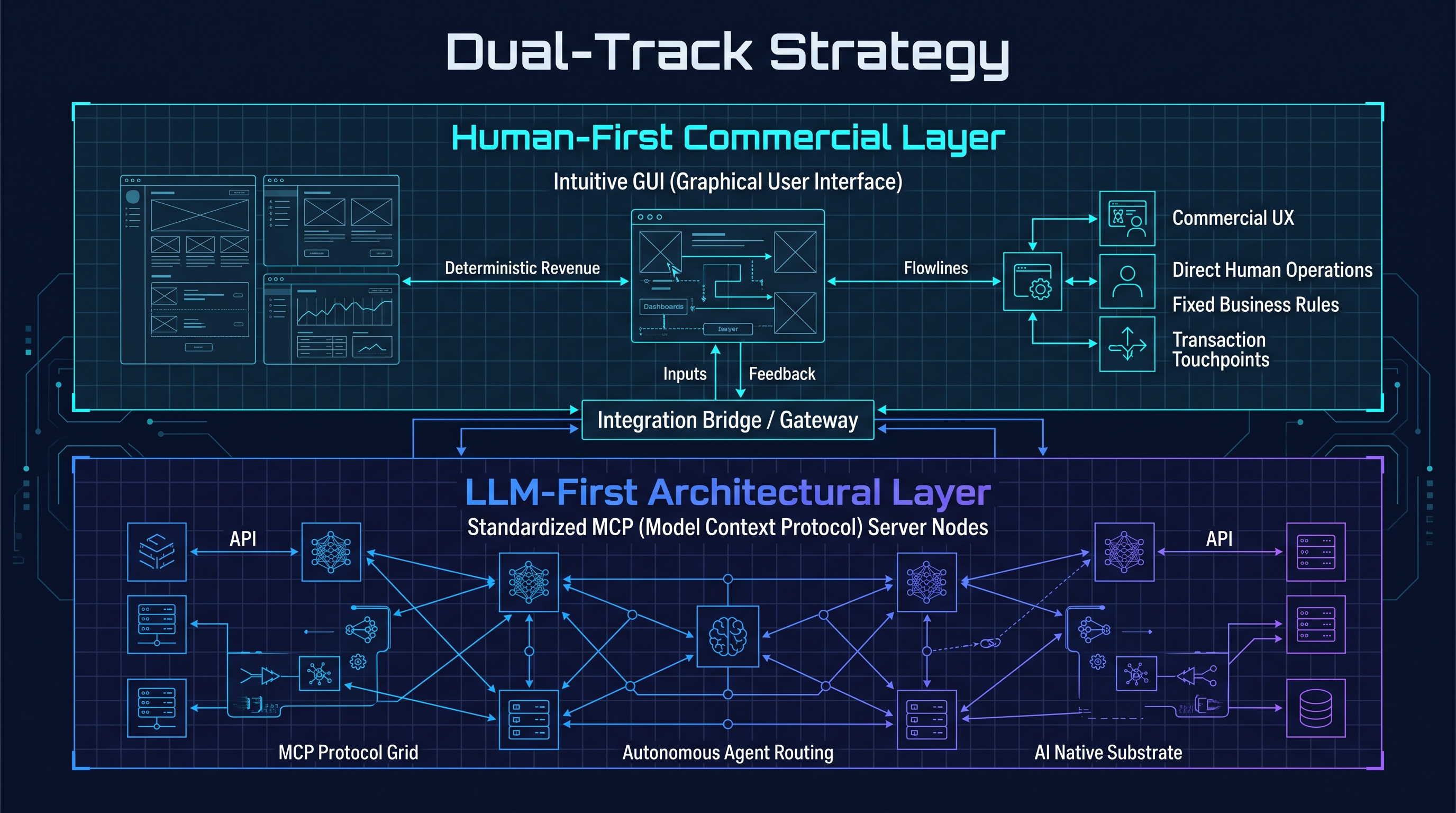
Specifically, we are executing a dual-track strategy—Human-First in Commercialization, LLM-First in Architecture:
- 1. The Commercial Layer (For Humans) — Bridging the L1-to-L2 Chasm for Deterministic Revenue: Since 99.45% of the world hasn't developed the habit of delegating end-to-end tasks to Agents—and a massive chasm with only a 2.2% conversion rate sits between L1 (2B) and L2 (45M)—the most lucrative goldmine today remains delivering complete, out-of-the-box products with intuitive UIs that solve immediate business pain points for humans. We no longer expect our customers to master prompt engineering, orchestrate agent workflows, or manually mount MCP servers. Instead, we wrap complex AI capabilities behind human-intuitive interfaces. Customers pay us for deterministic outcomes and frictionless software. This is the granary that funds our operations today.
- 2. The Architectural & R&D Layer (For LLMs) — MCP as the Core Substrate, Lying in Wait: Every feature module we ship to human users is atomically encapsulated under the hood using the MCP standard. In essence, our human-facing application is simply a 'Human View' rendered on top of our own MCP infrastructure. Over the past 19 months, L2 grew 30x, L3 grew 67x, and L4 exploded by 80x. When L2 crosses the chasm from 45 million early adopters to 450 million mainstream users, the primary caller of the software world will fundamentally invert. Because our underlying capabilities are built natively on MCP standards from day one, we can simply bypass the top-layer 'Human UI' and expose our battle-tested MCP interfaces directly to the global fleet of Agents—instantly transforming from a human software vendor into an Agent infrastructure provider.
Closing: Read the Clock Correctly, So You Don't Fall Before Dawn
The internet argues daily over whether AI is a bubble or an industrial revolution. In truth, people standing at different depths of the funnel are simply experiencing two completely different worlds. As builders living in the L3/L4 trenches, the most fatal strategic mistake we can make is projecting our daily frontier reality onto the mainstream market—mistaking the 'early teaser trailer' for a feature film already playing in every theater.
Admitting that AI is still early, and acknowledging that an LLM-only customer base cannot sustain core revenue today, isn't a compromise. It is the brutal realism required of every founder. Build products for humans to secure the rations and cross the cycle; forge MCP infrastructure for LLMs to stock the ammunition and lock in the endgame. The real story is just beginning. Our job is to ensure that on the day millions of concurrent Agents truly take over the software stack, we are still at the table—holding the sharpest infrastructure cards in the deck.