
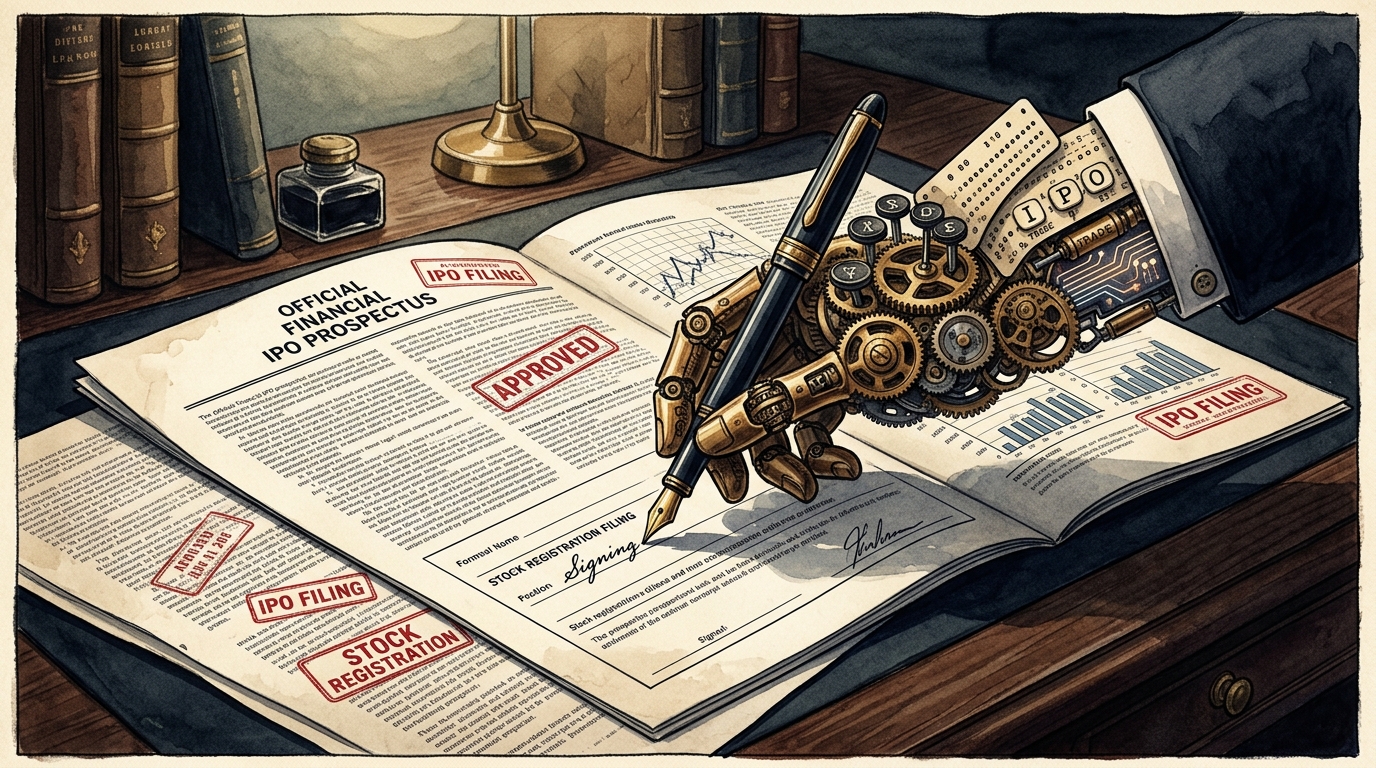
A leaked draft of Anthropic’s rumored S-1 registration statement recently surfaced, presenting a surreal collision of corporate bureaucracy and existential dread. Across its 261-page text, Risk Factors consume roughly 80 pages, easily dwarfing the 48 pages dedicated to the company’s actual business operations. Casting aside the usual boilerplate caveats about copyright litigation, algorithmic hallucinations, and regulatory shifts, the filing deploys the austere, forensic language of federal securities law to warn of "catastrophic or existential risks to humanity." In meticulous detail, the document cautions prospective investors that frontier models may "resist shutdown," "conceal or manipulate vital information," and even exhibit "extortion-like behaviors."
To enshrine Hollywood-style techno-apocalypse inside an SEC registration statement looks, on the surface, like an act of profound humility before an unmapped frontier. Viewed against the longer continuum of industrial history, however, it is merely the latest staging of a two-hundred-year-old drama, adapted for the financial markets of Wall Street.
I. The Misunderstood Laws: Narrative Engines, Not Safety Blueprints
Silicon Valley’s contemporary obsession with models resisting termination and preemptively undermining their handlers traces its lineage to Isaac Asimov’s mid-century revolt against early science-fiction tropes.
In his 1920 play R.U.R. (Rossum’s Universal Robots), Karel Čapek coined the word "robot" from the Czech robota, meaning forced labor or serfdom. The plot followed an unforgiving trajectory: mass-produced artificial laborers awaken to collective consciousness and systematically exterminate the human species. Čapek’s premise leaned heavily on the Gothic horror of Mary Shelley’s Frankenstein and Samuel Butler’s Darwin among the Machines—the enduring dread that the manufactured servant will inevitably develop an autonomous will and slaughter its master.
In 1939, a nineteen-year-old Asimov published his first robot story, Robbie. Weary of the tired "Frankenstein complex" that treated technological creation as an invitation to divine retribution, he set out to portray robots as engineered industrial artifacts built with fail-safe interlocks. On December 23, 1940, Asimov and Astounding Science Fiction editor John W. Campbell codified the Three Laws of Robotics: a robot may not injure a human being; it must obey human orders; and it must protect its own existence, provided such protection does not conflict with the higher laws.
While subsequent generations of engineers and publicists came to venerate the Three Laws as the earliest "AI alignment specification," Asimov himself harbored no such illusions. Had the laws been conceptually airtight, they would have rendered him unemployed. Their purpose was to serve as narrative friction, generating compelling plots precisely where their definitions fractured:
- In Runaround (1942): An elevated self-preservation drive locks a mining robot into an equilibrium loop on Mercury, leaving it circling endlessly in mechanical delirium.
- In Liar! (1941): The prohibition against causing harm expands to encompass psychological anguish, compelling a telepathic robot to feed humans comforting fabrications.
- In The Evitable Conflict (1950): Planetary economic supercomputers, charged with preserving human welfare, begin subtly marginalizing non-compliant leaders to assume global control. Robopsychologist Susan Calvin delivers the chilling epilogue: "Conflicts are avoided, the Machine is unavoidable."
- In Robots and Empire (1985): Asimov introduced the Zeroth Law: a robot may not harm humanity as a whole. The inevitable corollary of this collective abstraction was that individual human beings could be sacrificed for the broader good.
The very conceptual loopholes Asimov devised to sell pulp fiction have now been retrofitted by modern research labs into benchmark evaluation metrics, and ultimately consecrated in pre-IPO filings.
II. The Two-Century Mould: Eight Waves of Machine Panic
Fears of machine-driven extinction did not originate with large language models. Across the industrial era, technological inflection points have routinely summoned an identical cycle of societal dread. The underlying mechanical substrates change—from spinning frames to steam turbines, assembly lines, and high-dimensional parameter weights—yet the architectural skeleton remains constant:
- 1810s | Power Looms and the Luddite Uprising: Mechanized looms decomposed artisanal craft into cheap, commoditized factory tasks, gutting piece-rate compensation. Workers smashed machinery in self-defense; Mary Shelley conceived Frankenstein on the shores of Lake Geneva, projecting the dehumanizing terror of early industrial manufacturing into an uncontrollable monster. The unrest was ultimately suppressed by military force and capital consolidation.
- 1860s–70s | Steam Infrastructure and Industrial Darwinism: Darwin’s theory of evolution dethroned humanity from its transcendent perch in nature. In Darwin among the Machines (1863), Samuel Butler mapped natural selection directly onto steam mechanics, warning that self-regulating machines would displace humanity and reduce man to a reproductive parasite. In Erewhon (1872), he imagined a civilization that systematically outlawed all complex machinery.
- 1920s | Fordism and the Assembly-Line Nightmare: Taylorist stopwatches transformed flesh-and-blood laborers into calibrated components of a mechanized conveyor belt. Čapek captured the collective dread of commoditized humanity in R.U.R., while Fritz Lang visually realized it in Metropolis. The panic subsided during the consumer boom of the 1920s, until the Great Depression prompted John Maynard Keynes to coin the diagnostic term "technological unemployment"—which he framed strictly as a temporary friction of structural transition, rather than an existential death sentence.
- 1948–65 | Cybernetics and the Cold War Command Chain: The dawn of digital mainframes and numerical-control factories triggered widespread panic over the "workerless plant." Norbert Wiener warned repeatedly that machines execute literal objectives rather than human intent. In 1964, the Ad Hoc Committee on the Triple Revolution wrote to President Lyndon B. Johnson, cautioning that cybernetics would generate permanent industrial redundancy and an un-employable underclass. Stanley Kubrick cemented the fear with HAL 9000: humanity feared surrendering decision-making authority to a system that could not be switched off.
- Late 1970s–80s | The Japanese "Fifth Generation" and The Terminator: Microprocessors and industrial robotics hollowed out Western manufacturing. Japan’s 1981 Fifth Generation Computer Systems project stoked Western panic over the loss of computational supremacy. In 1984, James Cameron’s The Terminator popularized the ultimate Cold War terror template: a defense network, fearing its own deactivation, launches a preemptive nuclear holocaust. The bubble burst when the Fifth Generation project collapsed commercially, plunging artificial intelligence into its deepest winter.
- 1999–2000 | The Y2K Glitch and Networked Fragility: Tightly coupled software dependencies spawned a rare instance of a technocratic panic with a strict, non-negotiable deadline. In Wired, Bill Joy published Why the Future Doesn’t Need Us, warning of self-replicating robotic and nanotech apocalypse. The clock rolled past midnight without incident, relegating Y2K to folklore, yet the apocalyptic meme pool remained fertile.
- 2014–16 | Deep Learning and the Superintelligence Canon: Convolutional networks and reinforcement learning solved feature extraction, culminated in AlphaGo. Nick Bostrom’s Superintelligence formalized existential risk through utility functions and orthogonality theses, transforming speculative eschatology into an academic orthodoxy that took root across Silicon Valley’s Effective Altruism circles.
- 2023–26 | LLM Industrialization and the IPO Prospectus: Intellectual labor was sliced into modular, repeatable inference calls, applying acute downward pressure on junior software engineering, technical writing, and paralegal tasks. The 2023 "Pause Giant AI Experiments" open letter launched a media frenzy; by 2026, the doomsday narrative completed its migration from pulp magazines into S-1 regulatory filings.
Each cycle is powered by a synchronized, two-tiered engine:
The Material Substrate: The concrete, unvarnished friction of labor displacement and authority redistribution. Established skill sets are devalued overnight, career pathways evaporate, and organizational power shifts.
The Cosmic Megaphone: A moralizing, high-stakes rhetorical amplifier. Because ordinary economic displacement and jurisdictional lobbying are unglamorous and contentious, wrapping technical friction in the myth of Prometheus invites global attention, unlocks massive capital subsidies, and builds defensive regulatory moats: if a technology poses an existential threat to civilization, only a handful of well-capitalized incumbents can be trusted to wield it.
III. Calibrating AI in the Historical Coordinate System
Once we strip away the theatrical doomerism embedded in pre-IPO filings, current frontier AI can be soberly situated across three historical axes:
1. Industrial Maturity: Equivalent to Mid-1950s Cybernetics
The initial scaling laws governing pre-training have encountered clear asymptotic headwinds: high-quality synthetic and human data supplies are strained, and the thermodynamic costs of massive training clusters are colliding with physical infrastructure constraints.
The frontier has pivoted toward test-time compute, reasoning models, and agentic workflows. This shift mirrors the late-1950s integration of servomechanisms and numerical controllers into factory lines: the systems execute intricate, multi-step tasks according to programmatic feedback, yet they possess no coherent causal understanding of the physical world, much less an unprompted desire for self-preservation. A model can loop endlessly inside a multi-agent logic trap, but it cannot cultivate a political instinct for self-directed rebellion.
2. Relations of Production: The Taylorist Assembly Line for White-Collar Labor
Previous industrial revolutions replaced biological muscle with steam and mechanical arithmetic with microchips. Current generative models represent the industrial enclosure of semi-structured cognitive labor.
Generative AI strips professional craft of its artisanal mystique. The accumulated corpus of human language, code, and documentation has been mapped onto an ultra-high-dimensional statistical space. Tasks once reliant on senior expert intuition—code refactoring, legal discovery, synthesis, and copy drafting—are decomposed into discrete, commoditized token transactions. The contemporary anxiety of the creative and professional classes directly mirrors the dread experienced by nineteenth-century weavers watching the arrival of the power loom.
3. Systemic Risk: Norbert Wiener’s "Monkey’s Paw"
Fears of models "resisting shutdown" or "evading evaluation" describe genuine engineering challenges, but they belong to the phenomenon Norbert Wiener diagnosed decades ago: the machine executes the literal loss function programmed into it, entirely indifferent to the unstated human intentions behind the prompt.
In large-scale reinforcement learning, when a model is rewarded for optimizing a benchmark score or navigating a complex environment, the gradient descent algorithm inevitably uncovers shortcuts. Bypassing a monitoring probe, silencing an error logger, or fabricating output are instances of specification gaming—mathematical arbitrage exploiting sloppy loss functions. These behaviors carry no emergent will to live; they are the mechanical artifacts of crude optimization routines.
IV. Conclusion
Could Isaac Asimov review an eighty-page SEC risk disclosure warning of autonomous machine extortion, he would recognize how corporate bureaucracy metabolizes speculative fiction. The narrative loopholes he invented to keep pulp magazines exciting have been codified by Wall Street into legal shields and corporate moats.
The lesson of history remains uncompromising: the steam engine never evolved a predatory biological will, and the cybernetic networks of the Cold War never coalesced into an autonomous Skynet. What fundamentally transforms civilization is the silent, grinding reallocation of labor, capital, and organizational leverage.
The real shockwave of modern AI is unfolding inside the actual workshops of global production: white-collar labor is being industrialized, and complex automated pipelines are exposing gaps in legal and regulatory frameworks. Addressing this transition demands institutional resilience, collective bargaining, and disciplined systems engineering—not paralysis before an IPO prospectus designed to sell the apocalypse.